Category

Press Release

Fauda star Itzik Cohen: ‘The show has become a great force for bringing people together’

Itzik Cohen, who plays Captain Gabi Ayub on the hit Israeli TV show Fauda, wrote this guest blog for Creative Community For Peace (CCFP), expressing his views on the show and on its contribution to peace.

Fauda is a startup, a series that was made on a very low budget, and in the midst of the summer heat, with a great deal of tension of a possible war in the air. None of the actors or creators thought for a minute that the whole world would embrace the series. Most of us thought that even in Israel it would be considered a niche series.

Reality proved otherwise. In fact, Fauda changed everything we knew about Israeli Television and it became a phenomenon. Everyone who was part of the series upgraded their career.

But everything begins and ends with sensitive and meticulous work. The show’s creators, Lior Raz and Avi Issacharoff, together with Assaf Bernstein, the director of the first episode, placed an emphasis on the complexities and sensitivities of the characters, and insisted on not creating Jewish or Arab stereotypes.

This is the reason they cast me. I come from a background in comedy and musicals, and so fit beautifully as the opposite type cast for the dramatic and complex role of Captain Gabi Ayub. They didn’t want the stereotype of the tough and macho Shabak investigator, but instead wanted to reach the heart of the conflict in order to show how people find themselves in complex and dangerous situations that end up touching our hearts.

Read the rest on the Times of Israel: http://blogs.timesofisrael.com/fauda-star-itzik-cohen-the-show-has-become-a-great-force-for-bringing-people-together/

The Musrara School and the healing power of art

Creative Community For Peace (CCFP) recently visited Musrara: The Naggar Multidisciplinary School of Art and Society and spoke with people who are blending art and social activism to improve their neighborhood, their city, and their country.

The school brings artists from all over Israel to the Musrara neighborhood of Jerusalem in order to learn and to create. Students can choose from five different tracks: Photography, New Media, New Music, Visual Communication, or Phototherapy.

One of the things that separates the Naggar school from other art schools is that they encourage students not only to achieve artistic excellence in their fields, “but also to generate social change by contributing to and empowering the weak through community-based artistic volunteerism in Jerusalem and nationwide.”

This commitment to volunteering and social change is a big part of the reason why the school was located in the Musrara neighborhood. In 1987, when the school was founded, the neighborhood was in poor shape.

As a result of the conflict between Israel and Jordan, which each controlled half of Jerusalem between 1949 and 1967, Musrara was located in a no man’s land between the opposing sides. Residents of the neighborhood were often subjected to attacks by Jordanian snipers. As one can imagine, not many people wanted to live there.

However, during this time, hundreds of thousands of Jews were fleeing or being expelled from Arab countries and needed homes in Israel. Many of them, particularly those from North Africa, were settled in Musrara by the Israeli government. The neighborhood became a place of unemployment, poverty, and isolation, and remained that way for some time, even long after the war ended.

Mr. Sabag told CCFP that Musrara was not a neighborhood people were proud to say they were from. This negative perception was one of the things he set out to change when he founded the school, by bringing artists to interact with the community.

At the Musrara school, the artists don’t simply create art in the community or for the community, Mr. Sabag stressed. Rather, they create art together with the community. And the school doesn’t only affect the community, the community affects the school.

“The school operates in a real life space,” he said. “It’s affected by its immediate environment. Its identity as an art institution is sharpened by the history of the neighborhood and the history of the social struggle which strived to bridge the gaps in Israeli society.”

One example of the school’s current integration with the community is the Musrara Mix Festival, which will be held this year from May 29 to May 31. The school works with the community to install works in buildings throughout the neighborhood, in public spaces, and even in the backyards of the residents. The point is for the festival to be part of the neighborhood and for the residents of the neighborhood to have a stake in the festival.

While the heart and soul of the school is certainly centered around Musrara, they also look further afield. One of their programs, for instance, is a workshop for Arab women, teaching photography to Arab women from eastern Jerusalem and empowering them to become leaders in their community. And the general message of the intersection between art and social activism is a constant throughout the school.

“The parallel lines between the artistic field and the social field have been revealed to me, and continued to be revealed throughout my years of study and creativity,” said Yafit Reuveny, an alumni of the New Music Department. “They continue to be significant factor in the narrative I create in my works.”

We at CCFP — an organization comprised of prominent members of the entertainment industry dedicated to promoting the arts as a means to peace, defending artistic freedom, and countering the cultural boycott of Israel — are strong believers in the power of the arts to create positive social change, and we’re happy to see the Musrara School validating that belief in Jerusalem.

Entertainment execs condemn threats against Netflix by Boycott Israel movement

Dear Mr. Sarandos and Mr. Friedlander,

As the Chief Content Officer and Vice President of Original Series for Netflix, you’ve surely heard that Fauda, the hit Israeli television series which is distributed by Netflix and dramatizes the Israeli-Palestinian conflict, has found itself in an unusual situation. The anti-Israel Boycott, Divestment, and Sanctions (BDS) movement has threatened to sue Netflix if you don’t drop the show, which they claim encourages the “violation of international law and human rights.”

As an organization comprised of prominent members of the entertainment industry dedicated to promoting the arts as a means to peace and to defending artistic freedom, we at Creative Community For Peace (CCFP) want you to know that we stand behind you and Netflix in the face of this blatant attempt at artistic censorship.

The BDS movement seeks to isolate Israel in the cultural, academic, economic, and diplomatic arenas. Its myopic and simplistic anti-Israel worldview is threatened by the worldwide exposure Netflix has generated for Fauda’s nuanced portrayal of issues related to the Israeli/Palestinian conflict.

This worldview was evident in the letter BDS wrote to Netflix, in which they continued their habit of using inaccurate and inflammatory language, such as “colonialist” and “apartheid,” to describe Israel. As always, they assign every evil imaginable to Israel, while absolving the Palestinians of any and all responsibility or agency.

On the other hand, Lior Raz and Avi Issacharoff, Fauda’s co-creators, go out of their way to show the conflict — and the individuals caught up in the conflict — in all its complexity. Mr. Raz, for example, has said that he sometimes sits down with his Arab actors to rewrite scenes when they feel their characters are incorrectly portrayed.

This is the power of this show — and the reason it attracts legions of fans from around the world — which mirrors the power of the arts in general; they bring up difficult but important conversations, expanding our horizons and allowing us to experience different points of view. We wish the BDS movement would join us and the creators of Fauda — and Netflix, of course, for distributing Fauda — in striving for understanding and dialogue, which is the only path to peace.

“It’s a shame that the BDS movement continues in its campaign of divisiveness and hatred toward Israelis instead of focusing on other messages,” the show’s producer told The Wrap, referring to their demand. “It’s a shame they don’t see the messages we get from people in Turkey, Qatar, Dubai and other Arab countries who talk about how this series opened their eyes in regards to the Israeli-Palestinian conflict. People who once hated anything to do with Israel have been exposed to the complexity of the conflict and the humanity on both sides.”

Sadly, attempts to block true understanding and instead force a black and white, good versus evil view of the Israeli-Palestinian conflict upon the world are nothing new for BDS. In threatening to sue Netflix for distributing a television series with which they disagree, they have simply taken those attempts to the next level of absurdity.

We have every confidence that you and Netflix will disregard these threats and stand behind the show. We offer our assistance if ever you should need it.

Sincerely,

Jason Adelman, Head of Brand Strategy and Business Development, Habana Avenue

Orly Adelson, President of Orly Adelson Productions

Marty Adelstein, CEO of Tomorrow Studios

Michael Adler, Partner of Lichter, Grossman, Nichols, Adler & Feldman

Craig Balsam, Co-Founder of Razor & Tie Entertainment

Richard Baskind, Partner and Head of Music at Simons Muirhead & Burton

Aton Ben-Horin, Global head of A&R a Warner Music Group

Steven Bensusan, President of Blue Note Entertainment Group

Adam Berkowitz, Sr Television Agent at CAA

Josh Binder, Partner of Rothenberg, Mohr, and Binder, LLP

David Byrnes, Partner of Ziffren, Brittenham, LLP

Civia Caroline, President of Clic Entertainment

Josh Deutsch, Chairman/CEO of Downtown Records

David Draiman, Musician

Craig Emanuel, Partner of Loeb & Loeb LLP

Ron Fair, Record Producer and Former Chief Creative Officer and Executive VP of Virgin Americans

Marc Fineman, Founder and CEO of FINE

Erica Forster, Entertainment Industry Executive

Gary Foster, Principal of Krasnoff Foster Productions

Daryl Friedman, Chief Advocacy & Industry Relations Officer of The Recording Academy / GRAMMYs on the Hill

Andrew Genger, Red Light Entertainment

Gary Gersh, President of Global Talent at AEG Presents

Jody Gerson, Chairman and CEO of Universal Music Publishing Group

Gary Ginsberg, Executive Vice President of Corporate Marketing and Communications of Time Warner Inc.

Daniel Glass, President and Founder of Glassnote Entertainment Group

David Glick, Founder and CEO of Edge Group

Andrew Gould, Music Executive

Trudy Green, Trudy Green Management/HK Management

Ari Ingel, Denovo Music

Neil Jacobson, President, Geffen Records

Larry Katz, Entertainment Attorney

Zach Katz, Chief Creative Officer of BMG Chrysalis, North America

Amanda Kogan, WME

Rick Krim, West Coast President of Sony/ATV Music Publishing

Colin Lester, CEO of JEM Artists

David Levy, William Morris Endeavor Entertainment (WME)

David Lonner, CEO of Oasis Media Group

Ben Maddahi, President of Unrestricted

Scott Packman, Esquire

Donald S. Passman, Partner of Gang, Tyre, Ramer, and Brown, Inc.

Dean Raise, Manager at C3 Presents

David Renzer, Chairman of Spirit Music Group and Former Chairman/CEO of Universal Music Publishing Group

Hanna Rochelle, Founder and President of Lyric Culture

Rick Rosen, Head of Television Department at William Morris Endeavor Entertainment (WME)

Steve Schnur, Worldwide Executive and Music President of Electronic Arts

Sam Schwartz, Co-Principal of Gorfaine/Schwartz Agency

Paul Schindler, Senior Chair of the New York Entertainment and Media Practice, Greenberg Traurig, LLP

Ben Silverman, Chairman and Co-chief Executive Officer of Propagate Content

Ralph Simon, Chairman & Chief Executive Officer of Mobilium Global Limited

Jeff Sosnow, SVP Artist and Repertoire at Warner Music Group

Gary Stiffelman, Partner of Greenberg Traurig LLP

Aaron Symonds, Film Composer

Traci Szymanski, President of Co-Star Entertainment/Israelife Media Group

Adam Taylor, President of APM Music.

Sharon Tal Yguado, Head of Event Series at Amazon

Jonathan Yunger, Co-President of Millenium Media


*Please note that all companies are listed for affiliation only.

When Music Kills

We at Creative Community For Peace (CCFP) have long admired the ability of art and music to bring people together. Art is our shared human language which can allow us to rise up above that which divides us in order to see what unites us on a deeper level. It lets us glimpse the world from different points of view, gain new perspectives, and wrestle with challenging ideas.

When it falls into the wrong hands, however, art can be misused to do the exact opposite; to divide people and perpetuate conflict, to push one ideology at the exclusion of all others and stamp out dissenting points of view.

Unfortunately, this is what we’re seeing from some Palestinian artists. A number of popular songs created by Palestinian musicians — and promoted widely by both Palestinian governments, the Palestinian Authority and Hamas — have been designed to incite violence against Israelis, widening the divide between the two peoples to the detriment of all in the region.

For example, in November of 2017, the official Palestinian Authority television channel broadcast a song which includes the lyrics, “Jerusalem is ours, and we are marching, and we will bring millions of martyrs,” as well as “[We] are soldiers until we break the Jews.”

Earlier in the year, a music video shown on Awdah TV, a station run by Palestinian President Mahmoud Abbas’s Fatah movement, included videos of violent protests and stabbing attacks, with lyrics encouraging Palestinians to become martyrs for Jerusalem by attacking Israelis.

During the uptick in violence in late 2015 and early 2016, known as the “knife intifada” or the “stabbing intifada,” songs that glorified stabbing attacks against Israelis were all the rage on the Palestinian street. The Times of Israel noted that anybody who spent time in Palestinian cities was sure to hear a song called “Lovers of Stabbing,” by a Palestinian band from Gaza, blaring from cars, stores, and restaurants.

According to the Palestinian Maan News, this song encouraged “Jerusalemites and revolutionaries in the West Bank to carry out stabbing operations and to kill settlers,” and these violent songs inspired young Palestinians to follow in the footsteps of the terrorists the songs glorify.

It’s truly disheartening to see artists — who have such a unique and powerful ability to promote unity — use their voices to incite violence and tear people apart.

We at CCFP don’t have a solution to this problem, but the first step is surely recognizing that there is one. We call on all artists — Israelis, Palestinians, and those from all over the world — to raise their voices against hate, and instead cry out for peace.

Dream Defenders is misleading rapper Vic Mensa and other artists about Israel

Grammy-nominated American rapper Vic Mensa recently published an article in TIME magazine wherein he compared the experiences of Palestinians to his experiences as a black man in America.

This article, unfortunately, contains a great deal of inaccuracies and omits a great deal of context. The fault for this lies less with Mr. Mensa and more with Dream Defenders, the organization that planned his trip to the region.

“I do not pretend to be familiar with every nuance of the longstanding turmoil that engulfs Israel and Palestine,” Mr. Mensa acknowledged in his article. “I can only speak to the experiences I had there.”

The problem is that the experiences he had there were carefully crafted by Dream Defenders, which makes no secret of its opposition to the very existence of the State of Israel, and which brought Black artists and activists on a delegation to the region to give them a view of the situation which would lead them to adopt the same position.

The description of the delegation on the Dream Defenders website includes shockingly incendiary and hateful language, including referring to Israel as a “settler colonial project” and accusing Israel of massacring Palestinians in order to test and sell military technology.

“After every Israeli assault against Gaza their sales have been a part of the package,” they write, evoking classic stereotypes of the greedy Jew.

Is it any surprise that an organization working to delegitimize self-determination for the Jewish people and the existence of the State of Israel would create a trip that makes Israel appear illegitimate?

As we so recently celebrated the life and legacy of Martin Luther King Jr., we can’t help but think of what this great man had to say about Israel and how he would have felt about a Black rights organization working to demonize it.

As Rep. John Lewis, a civil rights leader who worked with Dr. King, wrote: “On March 25, 1968, less than two weeks before his tragic death, [Dr. King] spoke out with clarity and directness stating, ‘peace for Israel means security, and we must stand with all our might to protect its right to exist, its territorial integrity. I see Israel as one of the great outposts of democracy in the world, and a marvelous example of what can be done, how desert land can be transformed into an oasis of brotherhood and democracy. Peace for Israel means security and that security must be a reality.’”

The world and the region have changed drastically since Dr. King was assassinated in 1968, but that much, at least, remains the same.

According to Clarence B. Jones, Dr. King’s attorney and close friend, Dr. King also “warned repeatedly that anti-Semitism would soon be disguised as anti-Zionism,” another term for opposition to the existence of Israel.

The anti-Zionism of Dream Defenders is in no doubt shaped in part by Linda Sarsour, an activist who serves as one of its eight Advisory Board members. Ms. Sarsour is an avowed anti-Zionist and a supporter of the discriminatory Boycott, Divestment, and Sanctions (BDS) movement, which works to isolate Israel in the cultural, academic, economic, and diplomatic arenas with the ultimate goal of ending its existence as the homeland of the Jewish people.  

We at Creative Community For Peace (CCFP) — an organization comprised of high-level entertainment industry figures dedicated to promoting the arts as a means to peace, defending artistic freedom, and countering the cultural boycott of Israel — hope Mr. Mensa will have the chance to travel back to the region and gain a wider perspective on this supremely complex conflict.

Jason Derulo, Alicia Keys, Freddie Gibbs, Rihanna, Damian, Julian, and Ziggy Marley, Bobby McFerrin, Craig David, Gloria Gaynor, Lisa Simone, Alan Youngblood Hart, Buddy Guy, Wiz Khalifa, Noname, and DJ Black Coffee, are just a few of the many Black artists who have traveled to Israel over the past several years and seen much more than the narrow worldview Dream Defenders showed Mr. Mensa.

Only by rejecting the uncompromising black and white narrative of groups like Dream Defenders and BDS and acknowledging the conflict’s many shades of gray can we hope to make any progress toward resolving it.

Entertainment industry group responds to Lorde’s Israel cancellation

We — the undersigned artists and entertainment industry executives — are deeply disappointed that Lorde canceled her show in Tel Aviv after receiving pressure from the radical boycott Israel movement. Artists should never become beholden to the political views of a small but loud minority.

The boycott movement, while often painting itself as a movement for human rights, is actually a political movement ultimately aiming to extinguish the State of Israel as the state of the Jewish people. Ignoring the many flaws in the other countries on Lorde’s world tour (including the US, the UK, and Russia), the movement singled out Israel —  and only Israel — for a boycott.

Over the past several years, many artists have come under the same pressure Lorde faced from this boycott group over the past week. Some have canceled their shows, but the vast majority — many hundreds, in fact — have stood strong. Recently, several artists have spoken out loudly and forcefully against the divisive, polarizing, and dictatorial nature of the boycott Israel movement.

“All of this creates divisive energy,” Thom Yorke of Radiohead said in June in response to the pressure he was receiving from boycott groups. “You’re not bringing people together. You’re not encouraging dialogue or a sense of understanding.”

The boycott movement is certainly not encouraging real dialogue or a sense of understanding. In fact, they are doing the exact opposite. The boycott movement has come out as a strong opponent of real dialogue between Israelis and Palestinians, even going so far as to denounce projects that work to bring young Israelis and Palestinians together through music.

“The kind of dialogue that they want to engage in is one that’s black or white,” Thom said. “I have a problem with that.”

Indeed, the entire narrative and worldview of the anti-Israel boycott movement is one that’s black or white, with no room for the shades of grey inherent in the immensely complex Israeli-Palestinian conflict. In their view, Israel is wrong and that’s the end of the story. As reasonable people realize, however, it is not quite that simple.

Artists are given a choice by boycott activists; either accept the entirety of the boycott narrative, which includes shockingly extreme and false accusations against Israel utilizing inflammatory language such as “apartheid” and “genocide,” and even comparing Israel’s actions to that of Nazi Germany, or become a target of relentless pressure and bullying.

“It suddenly became very important to make a stand against those people that are trying to shut down musicians, to bully musicians, to censor musicians, and to silence musicians,” Nick Cave said recently about his decision to perform in Israel in the face of boycott wrath.

Lorde became the target of that wrath, and we’re deeply disappointed that rather than rebuff the boycott movement and follow in the footsteps of Radiohead, Nick Cave, Lady Gaga, Rihanna, Justin Timberlake, and many other artists who have chosen to build #BridgesNotBoycotts, she canceled her show.

We, the undersigned, and the more than thirty thousand people who have signed our anti-boycott petition, will continue to work for a more peaceful future for Palestinians, Israelis, and the entire region. We truly believe that art and music can and should be part of the solution.

Jason Adelman, head of brand strategy and business development, Habana Avenue

Orly Adelson, president of Orly Adelson Productions

Marty Adelstein, CEO of Tomorrow Studios

Craig Balsam, co-founder of Razor & Tie Entertainment

Richard Baskind, partner and head of music at Simons Muirhead & Burton

Aton Ben-Horin, global head of A&R a Warner Music Group

Steven Bensusan, president of Blue Note Entertainment Group

Adam Berkowitz, co-head of the television department at Creative Artists Agency (CAA)

Josh Binder, Davis Shapiro & Lewit LLP

David Byrnes, partner of Ziffren, Brittenham, LLP

Civia Caroline, president of Clic Entertainment

Josh Deutsch, chairman/CEO of Downtown Records

David Draiman, musician

Craig Emanuel, partner of Loeb & Loeb LLP

Ron Fair, record producer and former chief creative officer and executive vp of Virgin Americans

Marc Fineman, founder and CEO of FINE

Erica Forster, vp of music partnerships at DanceOn

Gary Foster, principal of Krasnoff Foster Productions

Andrew Genger, Red Light Entertainment

Gary Gersh, president of global talent at AEG Presents

Jody Gerson, chairman and CEO of Universal Music Publishing Group

Gary Ginsberg, executive vice president of corporate marketing and communications of Time Warner Inc.

Daniel Glass, president and founder of Glassnote Entertainment Group

David Glick, founder and CEO of Edge Group

Andrew Gould

Trudy Green, Trudy Green Management/HK Management

Larry Katz, entertainment attorney

Zach Katz, chief creative officer of BMG Chrysalis, North America

Amanda Kogan, WME

Rick Krim, west coast president of Sony/ATV Music Publishing

Colin Lester, CEO of JEM Artists

David Levy, William Morris Endeavor Entertainment (WME)

David Lonner, CEO of Oasis Media Group

Ben Maddahi, president of Unrestricted

Scott Packman, esquire

Donald S. Passman, partner of Gang, Tyre, Ramer, and Brown, Inc.

Dean Raise, manager at C3 Presents

David Renzer, chairman of Spirit Music Group and former chairman/CEO of Universal Music Publishing Group

Hanna Rochelle, founder and president of Lyric Culture

Rick Rosen, head of the television department at William Morris Endeavor Entertainment (WME)

Steve Schnur, worldwide executive and music president of Electronic Arts

Sam Schwartz, co-principal of Gorfaine/Schwartz Agency

Ben Silverman, chairman and co-chief executive officer of Propagate Content

Ralph Simon, chairman & chief executive officer of Mobilium Global Limited

Jeff Sosnow, SVP artist and reportoire at Warner Music Group

Gary Stiffelman, partner of Greenberg Traurig LLP

Aaron Symonds, film composer

Traci Szymanski, president of Co-Star Entertainment/Isrealife Media Group

Adam Taylor, president of APM Music.

Sharon Tal Yguado, head of event series at Amazon

Please note that all organizations are listed for affiliation only.

Hundreds Attend Los Angeles Premiere of New Documentary Discussing Roger Waters. Global Anti-Semitism and the Boycott Israel Movement

Creative Community for Peace (CCFP) and the Simon Wiesenthal Center  – More than 200 people attended the LA premiere of the documentary “Wish You Weren’t Here,” hosted by Creative Community For Peace (CCFP) and the Simon Wiesenthal Center.

The film, by filmmaker and New York Times #1 best-selling author Ian Halperin, examines the actions and motivations of former Pink Floyd frontman Roger Waters, a major supporter of the anti-Israel Boycott, Divestment, and Sanctions (BDS) movement, in the context of the troubling rise in global anti-Semitism.

The film features interviews with leading figures including celebrated lawyer Alan Dershowitz, former UK Prime Minister Tony Blair, Ambassador Ronald S. Lauder, and CCFP co-founder and chairman/CEO of Spirit Music Group, David Renzer.

Following the screening, a panel of influential Hollywood executives held a Q&A.  Panelists included: David Renzer; Rick Rosen, WME Founding Partner and Head of Television; David Lande, Esq., entertainment attorney with Ziffren Bittenham; and filmmaker Ian Halperin. It was moderated by Moriah Films writer/director and Academy Award® winner Richard Trank. In attendance was Howard Rosenman, producer of the film, Call Me By Your Name. 

Capturing the theme of the evening and the importance of ending the cultural boycott of Israel, David Renzer stated during the panel, “We as the creative community are here to support our artists and to support the idea of art and culture…This isn’t about politics. This is about culture and arts, and that’s the message we have to remember…This is about the power that art, music, and culture have to be healing in this time when we need it more than ever.”

Together, the panelists have dealt with boycott related issues for Justin Timberlake, Alicia Keys, Scarlett Johansson, and many other high-profile artists.The full Q&A can be viewed here. Creative Community for Peace (CCFP) is an organization comprised of prominent members of the entertainment industry who promote the arts as a means to peace, support artistic freedom, and counter the cultural boycott of Israel. We understand the power that our music, our films, our television shows, and all arts have. We encourage artists to participate, rather than to shun, to express rather than to suppress. If anything, turn up the music, expose our art to wider audiences, and encourage people from all cultures to interact, communicate and inspire peace and understanding.
www.creativecommunityforpeace.com

The Simon Wiesenthal Center is a global human rights organization researching the Holocaust and hate in a historic and contemporary context. The Center confronts anti-Semitism, hate and terrorism, promotes human rights and dignity, stands with Israel, defends the safety of Jews worldwide, and teaches the lessons of the Holocaust for future generations. With a constituency of over 400,000 households in the United States, it is accredited as an NGO at international organizations including the United Nations, UNESCO, OSCE, Organization of American States (OAS), the Latin American Parliament (PARLATINO) and the Council of Europe. Headquartered in Los Angeles, the Simon Wiesenthal Center maintains offices in New York, Toronto, Miami, Chicago, Paris, Buenos Aires, and Jerusalem.www.wiesenthal.com

From Germany to Los Angeles, accusations of anti-Semitism piling up against Roger Waters

From the headlines he’s been making, it seems that former Pink Floyd frontman Roger Waters is becoming better known for his politics than for his music.

Take this week, for example, when German broadcasters made the decision not to air his concerts in Germany next summer following public backlash against his actions toward Israel, which are deemed by many to be anti-Semitic.

Waters is a vocal supporter of the Boycott, Divestment, and Sanctions (BDS) movement, which seeks to isolate Israel in the cultural, academic, diplomatic, and economic arenas with the end goal of eliminating it as a state.

In support of this movement, which is often accused of hypocrisy and discrimination for singling out Israel — and only Israel — among all the countries of the world, Waters spends a great deal of time putting pressure on his colleagues within the music industry to cancel their upcoming concerts in Israel, often using extreme and inaccurate language to convince them to do so.

For instance, he has compared the actions of the Israeli government to those of Nazi Germany, saying that the parallels between what Israel is doing to the Palestinians today and what Germany did to the Jews in the 30s are “so crushingly obvious.”

Considering Nazi Germany engaged in a systematic campaign of genocide against the Jewish people which resulted in the deaths of 6 million Jews — a third of the entire Jewish population of the world — whereas Israel is in a complex political struggle with the Palestinians that, though it has resulted in far too many deaths on both sides, cannot objectively be viewed as anywhere near the Holocaust in terms of scale or purpose, this is generally considered nothing more than a completely false way to delegitimize the State of Israel and to turn the Jews into the ultimate villain.

He has also used classic anti-Semitic language about an all-powerful Jewish lobby, claiming that other musicians are afraid to oppose it out of fear for their careers.

This has lead the Anti-Defamation League (ADL) — an organization which fights anti-Semitism and all forms of bigotry — to declare in 2013 that “anti-Semitic conspiracy theories” have “seeped into the totality” of his views.

Many musicians who have found themselves the target of Roger Waters’ BDS pressure — including Thom YorkeNick CaveAlan Parsons, and Dionne Warwick – have spoken out against him as well, accusing him of bullying and censorship.

Especially relevant after this week, the new documentary “Wish You Weren’t Here,” by #1 New York Times best-selling author Ian Halperin, examines the actions and motivations of Waters and the BDS movement in the context of the troubling rise in global anti-Semitism. On Tuesday December 5th, Creative Community For Peace (CCFP) and the Simon Wiesenthal Center will host a screening of the film at the Museum of Tolerance in Los Angeles.

Following the screening, a panel of influential Hollywood executives, together with Mr. Halperin, will hold a Q&A. Other panelists will include: CCFP co-founder David Renzer, chairman/CEO of Spirit Music Group; Rick Rosen, WME Founding Partner and Head of Television; and David Lande, Esq., entertainment attorney with Ziffren Brittenham. It will be moderated by Moriah Films writer/director and Academy Award® winner Richard Trank.

The event, which is open to the public, is expected to attract many high-level entertainment industry executives. Anybody wishing to attend should RSVP at this link. For those who don’t live in the Los Angeles area, the event will be live streamed on our Facebook page.

http://blogs.timesofisrael.com/from-germany-to-los-angeles-accusations-of-anti-semitism-piling-up-against-roger-waters/

“A Principled Stand”: Creative Community For Peace Responds To Roger Waters/ Nick Cave Controversy

Nick Doesn’t Cave

In his November 18th press conference prior to his two sold-out Tel Aviv concerts, Nick Cave explained why he was defying demands that he cancel these performances. It suddenly became very important,” Cave said, “to make a stand against those people who are trying to shut down musicians, to bully musicians, to censor musicians, and to silence musicians.” Cave was referring specifically to the open letter from the BDS-backed ‘Artists For Palestine’ – signed by personalities that include Roger Waters, Angela Davis and Thurston Moore – that employed such aggressively defamatory terms as ‘raiding and plundering’, ‘promotion of crimes’ and ‘apartheid regime’ to describe Israeli policies. If musicians choose to tour in Israel, Cave pointed out, they “have to go through a sort of public humiliation from Roger Waters and company.” Cave concluded with a boldly triumphant refute of the Boycott, Divest and Sanctions’ efforts: “So really, you could say, in a way, that the BDS made me play Israel,” he said.

“We hurl our glasses into the fire of your arrogant unconcern, and smash our bracelets on the rock of your implacable indifference,” Roger Waters responded, scoffing at Cave’s assertion that BDS demands for the cultural boycott of Israel is a form of artistic censorship. However, artists ranging from Paul McCartney to Radiohead to Gloria Gaynor have all described the bullying tactics of the boycott Israel movement and its self-designated spokesperson Waters. And it has become increasingly clear that Waters and company have something more in mind than changing Israel’s policies and promoting the rights of Palestinians: the BDS movement seeks to impose one-sided political change on Israel and is attempting to use strategies of disinformation to defame and isolate the country. Many in the BDS movement openly concede that their ultimate aim is to undermine the country’s legitimacy and even its right to exist. And boycotters who wish to keep artists out of Israel do so with the hope of turning it into a pariah state that will be generally vilified and rejected.

The Creative Community For Peace strongly believes that any orchestrated effort to silence artists is dangerously misplaced and counterproductive, and we support the courage of performers like Nick Cave, as well as Thom Yorke, Alan Parsons, Ozzy Osbourne, Morrissey, Boy George, Jerry Seinfeld, Charles Aznavour, Jon Bon Jovi, Carlos Santana and scores of other artists who have recently defied BDS demands to cancel their Israel tours. CCFP knows that concerts in Israel – despite being a place where audiences of Jews, Arabs and Muslims can come together in peace – won’t solve the conflict. But for Roger Waters, championing a movement that engages in artistic censorship and seeks to keep Israelis and Palestinians apart will certainly not hasten any peaceful resolution. Furthermore, these demands for cultural boycott seriously misunderstand the role the arts play in broadening dialogue and maintaining sound democracies.

CCFP welcomes discussions of Israel’s policies and actions, but we will not tolerate blatant misinformation, distorted versions of history, or a campaign for an end to the State of Israel. Independent-minded artists such as Nick Cave build bridges of consciousness and connectivity. And through the courage of artists like Cave and others, we can continue to choose to create pathways to peace.

The Museum on the Seam: Healing Jerusalem’s divides one exhibition at a time

The Museum on the Seam: Healing Jerusalem’s divides one exhibition at a time

By: Nick Lieber, Editorial Associate and Analyst, Creative Community For Peace


There is no shortage of creative and innovative projects working to build bridges between Israelis and Palestinians. For example, the Jerusalem YMCA Youth Choir brings people together through music; the Peres Center for Peace does so through sport; and the Museum on the Seam — which CCFP recently visited — uses socio-political contemporary art.

The Museum on the Seam is built — as its name attests — in an area referred to as “the seam,” which is an invisible line running through Jerusalem where the eastern side of the city, primarily populated by Palestinian Muslims, meets the western side, which is primarily populated by Israeli Jews.

After decades of national conflict, these places where Israelis and Palestinians intermingle can be places of tension and discord, and sometimes even violence. Some, however — including Raphie Etgar, the founder and chief curator of the Museum on the Seam — have seen their potential as places for nurturing togetherness and understanding.

The building the museum is housed in was formerly a military outpost stationed on the ceasefire line between Israel and Jordan, when the two countries controlled different parts of the city. Now, it houses socio-political contemporary art museum committed, in its own words, to “advancing dialogue in the face of discord and to encouraging social responsibility that is based on what we all have in common, rather than what keeps us apart.”

“This country bears so many conflicts and disagreements, every day, again and again,” Mr. Etgar told us. “Many good people in this country are trying their best to make a change and bring peace and common sense, or at least reduce the conflicts. This museum specifically, I thought to myself, would do the same thing but in a different way, and that is through art.”

For many years now, that is exactly what the museum has done; bridge gaps by facilitating dialogue and discussion through art exhibitions focusing on the social and political issues of the day. They don’t focus only on the Israeli-Palestinian conflict, but also on the various other conflicts present within Israeli society.

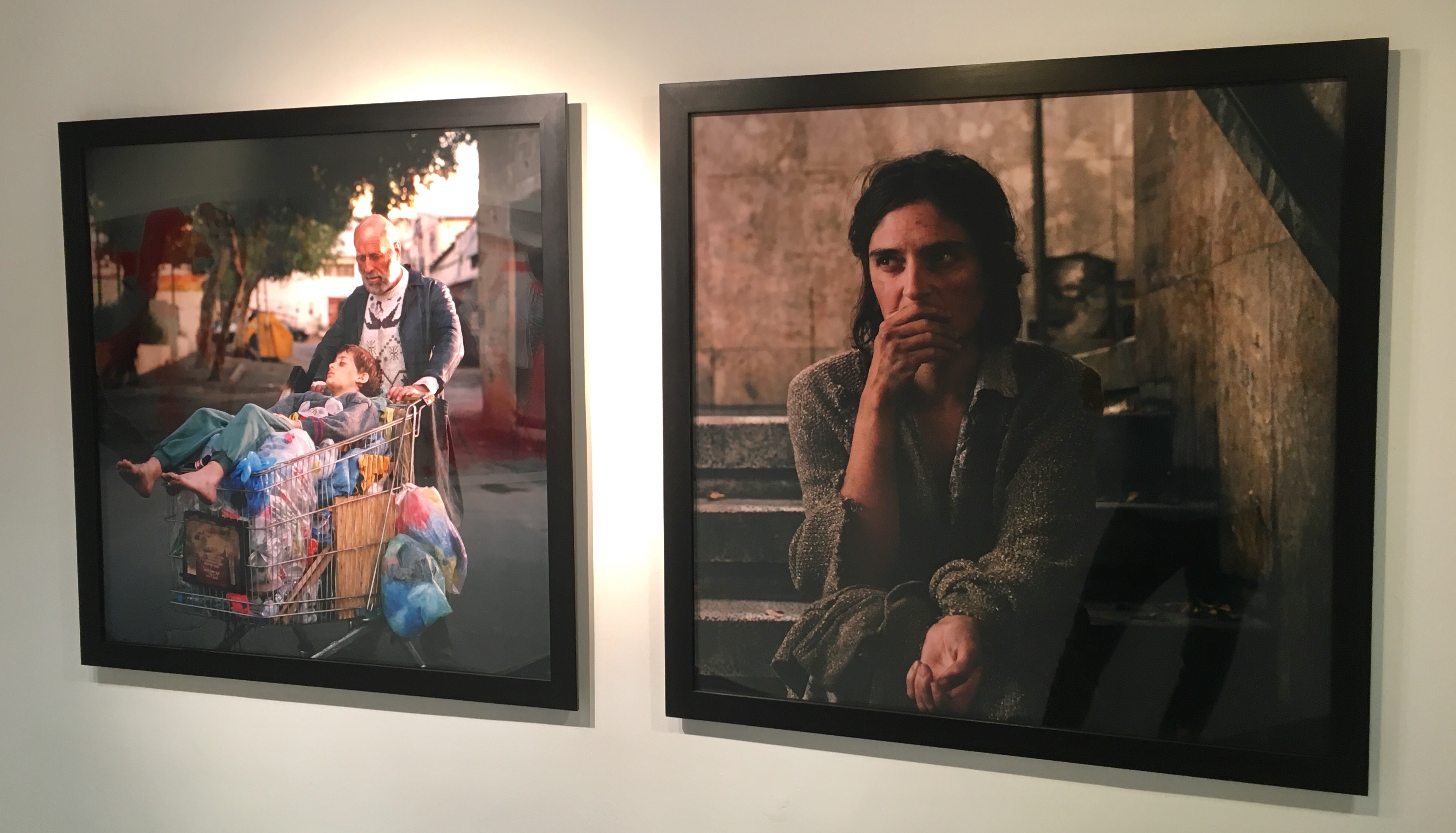
Their current exhibition, called “Thou Shalt Not,” examines the intersection between religion, which is often rooted in tradition and a disinclination toward change, and contemporary art, which serves as a mirror reflecting the rapidly changing times. The exhibit features works by 30 artists, half of whom are religious and half of whom are secular.

These photos by Israeli artist Adi Nes adapt biblical stories to our time and turn them into a social message. The left is inspired by the story of Abraham and Isaac, and the right is inspired by Hagar.


“We don’t think that our exhibitions are right or wrong, because this is not the point. The point is to put things on stage and let people discuss it. The discussion is the most important thing, because the discussion — if people do it the right way — brings them closer,” Mr. Etgar said. “The museum is here to let people meet, and maybe this is the way they will agree. If not on everything, then on something. And that is quite enough.”

In the past, their exhibitions have facilitated discussion on the problem of violence within Israeli society, the interaction between humans and nature, issues of discrimination, exploitation, and humiliation, and much more.

One of their most popular exhibitions, called “Coexistence,” was designed to bring a positive message of diversity and acceptance to the world community. It features works created by artists from all over the world and is still traveling to various locations, now having visited more than 30 cities.

As Mr. Etgar sees it, one of the most important things these exhibitions have demonstrated is that people, even those who would consider themselves enemies, are more closely connected than they might think.

“There’s always part of ‘the other’ in ourselves,” he said. “If you take the time to think about it, you’ll realize that even your enemy has some part in you. It might be the part that upsets you, makes you angry, makes you concerned, but this is the part that’s in you. It’s part of you and there’s nothing you can do about it. I believe that we don’t think completely isolated from all these parts that are included in us.”

At CCFP, we applaud the work that is being done to build bridges through art at the Museum on the Seam, and look forward to a more peaceful future.

X